
Rocker Arm for valve actuation in internal combustion engines (US Pat. 7,171,930)
Abstract
A rocker arm is disclosed for valve actuation in an internal combustion engine. The rocker arm includes at least two rotational axes which can be selected as desired to modify a relation between a force arm and a load arm. Control times and valve lift can be influenced in a targed manner.
Inventor: Alberto Keel, Switzerland
Foreigen Application Priority Data: Aug. 20, 2002 (CH)
Related U.S. Application Data: May 14, 2003
Filed: Feb. 22, 2005
Prior Publication Data: Aug. 4, 2005
Status: Expired

How it works (Basics of U.S. Patent 7,171,930)
Two pivots
Low-lift mode
High-lift mode
Switchover process


The main element of the invention is an eccentric integrated into the rocker arm body. Each eccentric has two pivots. The first pivot is formed by the outer circumference of the eccentric (marked in red).
The second pivot is formed by the bore of the eccentric (marked in yellow).
In low lift mode, the rocker arm body rotates around the outer diameter of the eccentric, while the eccentric does not move (supported by a stop plate... see animation on the right).
In high lift mode, the rocker arm body rotates together with the eccentric around the eccentric bore. The eccentric is connected to the rocker arm body by a mode pin to form a single unit (see animation on the right).
Switching between the two operating modes is performed by a hydraulically actuated mode pin.
When oil is pressed into the rocker arm from the main shaft, the mode pin is pushed outwards. The connection between the rocker arm body and the eccentric is released. The rocker arm operates in low lift mode.
When the oil pressure is released, a spring (not visible in the animation) pushes the mode pin against the eccentric and connects it to the rocker arm body. The rocker arm now operates in high lift mode.
Advanced knowledge & option for a follow-up patent
The full potential of these variable rocker arms can only be achieved in combination with solid lifters and the corresponding solid camshafts.
With solid lifters and solid camshafts, it is essential to set a valve clearance that ensures that even under extreme operating conditions (under full load and at high speeds), the valves always close completely despite the enormous heat exposure (expansion).
Under low load conditions and at low speeds (e.g., while cruising), the operating valve clearance naturally increases due to the lower heat input.
This variable rocker arm system cleverly utilizes the operating valve clearance available in low-lift mode in particular to influence the valve timing and valve overlap. In addition, the invention has another unique feature that makes it possible to assign different valve clearances to the two operating modes, high-lift mode and low-lift mode
This unique feature is a secret of the inventor and has never been published or mentioned to date. It is already integrated into the V-TEC rocker arm system, but has deliberately not been shown in any images or animations, either on this website or anywhere else.
This feature is therefore patentable and could be registered as a follow-up patent based on U.S. Pat. 7,171,930 (which has already expired).
It can be assumed that the follow-up patent would be recognized and granted. The rocker arm system with this unique feature could thus be protected by patent law for another 20 years.
This feature will not be published. This option is included in the scope of sale. It will only be disclosed to the five highest bidders and only upon signing a confidentiality agreement.
Back to Home
The relationships between rocker arm ratio, valve clearance, valve timing, valve overlap and valve speed
The following principles apply (logic):
-
The smaller the rocker arm ratio, the flatter the valve lift curve.
-
The flatter the valve lift curve, the more camshaft or crankshaft rotation degrees are required to compensate a specified valve clearance.
The resulting effects are shown in the following diagrams.
Valve opening ramp

This diagram shows the different positions (crankshaft degrees) at which the valve begins to open, depending on the rocker arm ratio and three different valve clearance settings.
Valve duration
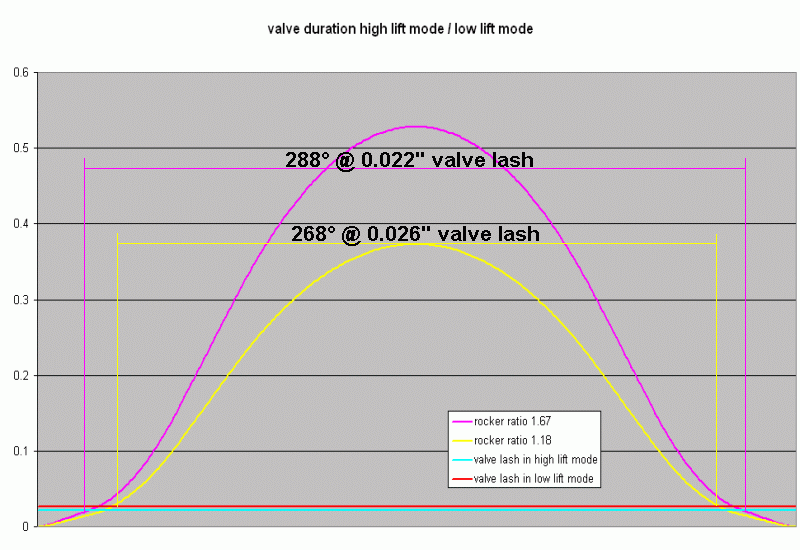
This diagram shows the effective valve opening times in crankshaft degrees, depending on the rocker arm ratio and valve clearance.
Valve overlap
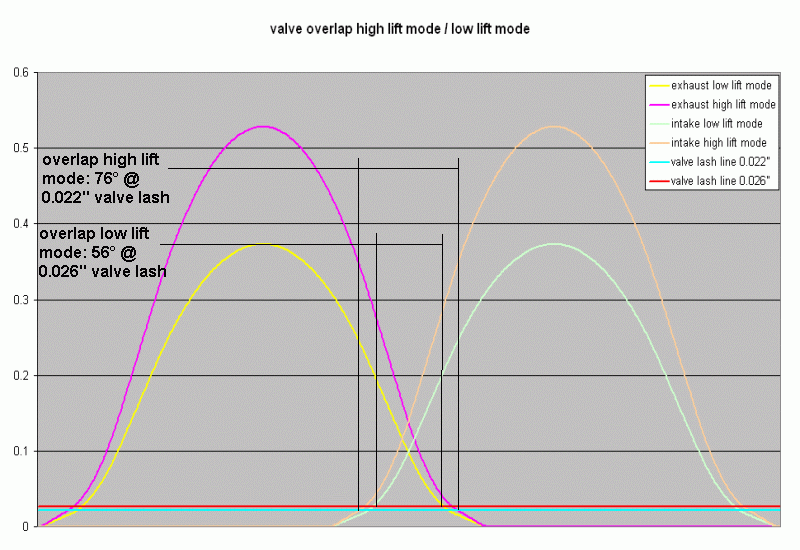
This diagram shows the effective valve overlap in crankshaft degrees, depending on the rocker arm ratio and valve clearance.
Valvetrain noise

This diagram shows the speeds at which the valve is struck by the rocker arm, also depending on the rocker arm ratio and valve clearance.
The angles shown are directly related to the impact speed and, accordingly, to the noise generated by the valve train.